Jonah was a wise mariner. He recognized that there is a time to sacrifice for the greater good of his boat mates. He also knew that any shelter, even a whale's belly, is the best place to be in a storm. I am not sure that New England rowers are that smart.
Yesterday morning, March 13th, I went out in a mixed 4+ in the beginning of a true New England Nor'easter'. It was an optional row, with no other reward than the sheer joy of being on the water.
I arrive on that cool, overcast morning at the boathouse. Weather predictions include a severe storm advisory. As I step out of my car, the first sprinkles hit the windshield, and the wind begins to blow.
Inside, Peter is on the erg, warming up. Peter and I are in the same winter training class. I like his commitment. I like his urge to improve. He looks up cheerfully and says "I can stay and erg, if you want to bail." He immediately follows with "but I am willing to go out and give it a go."
Yay. That's a man I want in my boat!
We head downstairs to the lobby, where Cissy, decked out in pink, is stretching her hamstrings. She looks up with a big grin and says "I can't wait to get out there! Where's Jim?". Cissy is the energizer bunny. At 5am, or 6pm she is bundles of happiness, and doesn't slow down. I have been in her boats where she calls power 20s, power 50s, and power 70s. She doesn't know when to quit.
Jim is the newest member of our sorry patched-together foursome. He is a REAL rower. He has rowed forever. He knows about Proper Technique. He has rowed long enough to have evolved his stroke. He has fast splits. And, he is big. Which, in the world of rowing, is a huge advantage. Every bit of that bigness, and every bit of that tallness can be converted into moving a boat forward faster. He also keeps everyone laughing. When Jim shows up to a workout, everyone is just a little more upbeat. A little more willing to push themselves just a bit harder. And he is the poster child for teamwork. He cheers others on. He smiles after the most grueling workout. And his smile is contagious. We are always happy around Jim.
So, when Jim walks through the door, I know he won't back out. I know he will let rain and wind slap across his face and his smile will not waver. He was hand-picked for a day like this. We are in for some misery, and a quick joke and encouraging cheer will keep us moving.
Our little coxswain, Vivian, is all bubbles and joy. Really, given the weather, we are all awfully happy. Like an advertisement for antidepressants. That is what happens to rowers after a long winter of erging. Bears are cranky when they come out of hibernation. Rowers are giddy. Getting out on the water puts a bounce in anyone's step after a winter of body odor and accumulation of sweat.
We choose our oars and pick out a boat. "Hands on!" the coxswain calls. I feel the excitement building. "Split to shoulders" and we face out of the boat bay. And that is when I first see the sleet. Coming down sideways. In a 30 knot wind. Gulp. I glance at the coach, and worry that the weather will cause him to reconsider. He shows no signs of weakness. Good. We chose him well.
"Walk it forward!" And we do. The bow of the boat, once free of the shelter of the boathouse, is pushed by the wind. We hang on and march down the dock, as straight as we can manage. The wind is strong. The waves are big. The rain and sleet are increasing. And we persevere.
It takes some doing to push off of the dock. The wind keeps pushing us back. Bow seat (Cissy) has to take some hard strokes to turn us out. Then, as bow pair, she and I haul for all we are worth to get us out of there.
I was told afterward that my favorite Harvard rowers were on the water just then. The ones I can never keep my eyes off of, with their slow, strong strokes, and lovely muscular bodies. Today I see nothing. I am heaving and hawing, trying to keep us moving forward. The Harvard heavies walk through us, and I never notice. There is a first time for everything.
We do some pick drills, and row by pairs on the square into the wind. Every millimeter of my squared oar is met with the resistance of the 30 knot wind. My hands are slow as they move away from my body, but I swear half of it is due to the wind.
Cissy and I row hard, but we aren't used to the wind, or the heavy stern pair, and the shore line doesn't move an inch. Despite all of our effort, we are just barely staying in place. When we finally switch pairs, the boat lurches forward. Our bow-pair's combined 250 pounds mean nothing to those strong men, at more than half-again our weight, as they bend their oars, and we gain momentum. When the coxswain (whose cox-box has shorted out in the rain) yells for us to add in, we finally feel some momentum propelling the boat ahead into the wind.
Four of us, working together, may be able to move this boat! My grin gets wider.
I am sitting behind Jim. His boathouse jacket exaggerates his size, and my field of vision is the red and black of his gortex. I try to keep in time with the movement of his body--press and release...hands away, body over...slowly up the slide... The waves are high, and periodically splash over the side of the boat and break--CRASH!--onto Jim's back. He is sitting in a puddle, and I know it is cold. While his jacket may be waterproof, his pants are not. I mentally check in with my own seat and realize that it, too, is wet. I am sure my back has been hit by some waves as well.
We finally go into some steady state pieces, all the time at a stroke rate of 16. That is what happens when a heavyweight is stroke seat. I keep my slide slow and pull hard, trying to keep down with this rate. I feel strong, but slow. I am used to compensating for my small size by rowing faster. This is pure torture.
I notice that Peter's oar is faster out of the bow than mine. His Serbian coach is a fan of "fast hands away", whereas mine subscribes to the belief that the hands should move out at the speed they moved in. So we gallop--Da-dum--with each stroke. My hands are too slow, and he hangs at the catch. Our drives are synchronized, but we jerk at our own paces on the recovery. And try as I might, I just cannot match his rhythm. Something to work toward. But for now, we just lurch along in dyssynchrony.
After a long hard haul into the headwind, we spin and come back up river. A tail wind is a lovely thing. While we are stopped for a water break, the wind blows us 200 meters up the course. It also blows the sleet into my face, rather than my back. My sweaty body grows cold. Jim suggests a faster stroke rate "for the lightweights in the bow". I feel a wave of gratefulness surge up inside me. Jim, the team player, is always seeking compromise.
"Ready? and Row!" calls our loud, diminutive coxswain in her "man voice". "You are at a 16, up to 18 in two!" and we begin our climb into more familiar stroke rates. The wind scurries us along, and we pull hard and fast, and feel like olympians. Very very wet olympians. With 5 inches of water sloshing at our feet, and a slight crust of ice on our riggers.
I figure Jonah was smarter than we are. He looked around at the high winds, the big swells and the heavy (sideways) driving rain, and headed immediately for the shelter of a cetacean's gastrointestinal
calm. God spoke and Jonah listened.
When God speaks to us, all we know is to pull harder. We tough it out, boat tossing to and fro, waves crashing over the gunwales, sleet driving into our cheeks, my slow hands away, Peter's hanging at the catch, Cissy's late squaring oars, and Jim's seat in a puddle.
When we finally dock, after a final fast piece, I couldn't wipe the smile off my cold, wet face! I look around at my boatmates, and see my joy mirrored in their own. We give each other happy fist bumps and giddy hugs, and all agree that this was the best (and first) row of the season!
Jonah didn't know what he was missing.
Thursday, April 1, 2010


Monday, March 1, 2010
bench pulls
Yesterday, in my weight lifting class, we had to do another bench pull test. I hate these tests. I am almost 44 years old, and haven't been in school for years. I have no interest in tests. I just want to row.
But rowers just can't let go of tests. I have had to do 2k tests, 5k tests and 6k tests. In another month I will be doing more tests, and comparing my tests with other middle-aged women's tests to figure out how fast or slow I am or where I might fit best in a boat. Actually, there are more young women than middle-aged women in our rowing club. So my tests will be compared with the 25 and 30 year olds' tests. If only these tests measured wisdom, or communication skills, or maturity, number of children raised, or how to figure out a retirement investment plan. I could whoop most of their young butts at those tests.
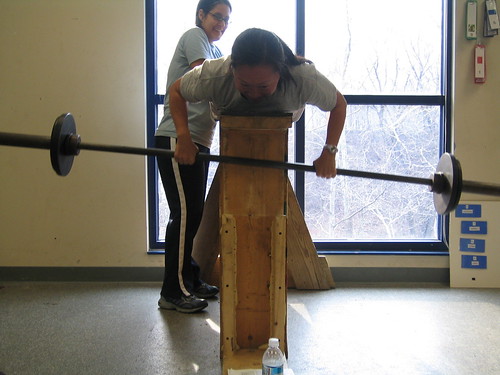
But no. Now I have to lay my middle-aged body across a rickety wooden bench, and yank a 45 pound bar up to my chest, bang it against the board underneath me with a clank, and drop it back down to full extension. I have to do this as many times as I can muster in 60 seconds.
I have done this test before, and I have never gotten a passing grade. In the world of bench pulls, where 60 is an A, and 50 is a B, 40 is a C, etc.I have never gotten above a D minus. In truth, my D minus is a pity grade, just for showing up. Because Tom (the very sweet-natured instructor) just cannot bring himself to utterly fail anyone who at least tries.
Of course, there is no actual grade given for this ridiculous test. It is like the SATs--no failing and no passing, but wander the halls for a day and you know who got the highest score, and you know how you stack up to your peers. The bench pull test is like that. All that peer pressure of adolescence without the pimples.
I love the strong women who are older than I am and can bench press what I weigh. There are several of them, and they are my role models. I want to be them. I want to row like them. I want to erg like them. I want to bench pull like them. They are strong, but also very supportive. If I bench pull 12 times they clap me on the back and say "good job, Robyn!". A few weeks later, when I bump it up to 20, they cheer about my improvement. When the bench tips forward because my legs aren't heavy enough to keep it balanced, they stand behind me and hold the bench down. They keep me from falling off, and they keep me from quitting. They make it feel less like a competition that will seal my rowing fate, and more like a measure that I am making progress.
So when Tom announces that we are doing another bench pull test, I decide to jump on that blasted rickety bench and pull that rotten steel bar as many times as I can--I will improve, dammit. I will do better. I will not tip forward on my head. I will not fail.I will make these women proud.
Jen is my partner and she helps me lay weights across the back legs of the bench, to make it more stable. She gives me a big grin and gives me pointers. "Pull like hell for the first half. Your arms will get tired then no matter how many times you have pulled, so you might as well get as many in as you can."
Ah. Strategy. I like it. There is a trick in here somewhere.
Jen looks at the clock. "5 seconds...3...2...1...GO!"
And I haul on that bar "1-and-clank-and-2-and-clank-and-3-and-clank......and I reach 30 just as Jen says "30 seconds--half way there".
Wow. In half a minute, I have already broken my previous record.
I pull two more times and the pain starts. A numbing fire in my biceps simultaneously travels both up and down my arms. I pull again. The grip on my hands weakens. One...and...clank...and...two...I stop with my arms extended, my chest muscles contracting down on my lungs...one...and...clank...and...rest...gasp...sigh....
"Only 15 seconds longer" Jen warns....or is it a promise of hope?
One more....ugh....clank...again...gasp....screaming pain up into my shoulders....one-half....groan....three-quarters....I heave the bar up--not quite to the bench--I grunt it up all the way--clank--and drop it down.
"5 more seconds"
ssssslooooooowly I pull it up again...arms shaking....clank--and drop the bar down, and again....oh my god.....I am going to explode....my arms are falling off....CLANK....
"Stop!"
I did it. The bar almost falls out of my hands. I roll off the bench onto the floor, my biceps quivering, my hands frozen in a permanent claw.
This is a strange and wonderful feeling. My legs are fine--no discomfort. But my chest is collapsed--I wonder if I need a chest tube to allow some air in--and my arms have stopped feeling altogether. I flop them out beside me on the floor. I have to look to make sure they are still connected to my body.
Yup. Two arms. One left. One right. No sensation whatsoever.
Tom comes over and reaches down to help me up. I slowly lift one hand to meet his. He hauls me to my feet, and grins. "Nice job, Robyn!"
I smile proudly. Until his next words.
"Lets get ready for a 20 minute bar circuit"
Oh. Shit.
But rowers just can't let go of tests. I have had to do 2k tests, 5k tests and 6k tests. In another month I will be doing more tests, and comparing my tests with other middle-aged women's tests to figure out how fast or slow I am or where I might fit best in a boat. Actually, there are more young women than middle-aged women in our rowing club. So my tests will be compared with the 25 and 30 year olds' tests. If only these tests measured wisdom, or communication skills, or maturity, number of children raised, or how to figure out a retirement investment plan. I could whoop most of their young butts at those tests.
But no. Now I have to lay my middle-aged body across a rickety wooden bench, and yank a 45 pound bar up to my chest, bang it against the board underneath me with a clank, and drop it back down to full extension. I have to do this as many times as I can muster in 60 seconds.
I have done this test before, and I have never gotten a passing grade. In the world of bench pulls, where 60 is an A, and 50 is a B, 40 is a C, etc.I have never gotten above a D minus. In truth, my D minus is a pity grade, just for showing up. Because Tom (the very sweet-natured instructor) just cannot bring himself to utterly fail anyone who at least tries.
Of course, there is no actual grade given for this ridiculous test. It is like the SATs--no failing and no passing, but wander the halls for a day and you know who got the highest score, and you know how you stack up to your peers. The bench pull test is like that. All that peer pressure of adolescence without the pimples.
I love the strong women who are older than I am and can bench press what I weigh. There are several of them, and they are my role models. I want to be them. I want to row like them. I want to erg like them. I want to bench pull like them. They are strong, but also very supportive. If I bench pull 12 times they clap me on the back and say "good job, Robyn!". A few weeks later, when I bump it up to 20, they cheer about my improvement. When the bench tips forward because my legs aren't heavy enough to keep it balanced, they stand behind me and hold the bench down. They keep me from falling off, and they keep me from quitting. They make it feel less like a competition that will seal my rowing fate, and more like a measure that I am making progress.
So when Tom announces that we are doing another bench pull test, I decide to jump on that blasted rickety bench and pull that rotten steel bar as many times as I can--I will improve, dammit. I will do better. I will not tip forward on my head. I will not fail.I will make these women proud.
Jen is my partner and she helps me lay weights across the back legs of the bench, to make it more stable. She gives me a big grin and gives me pointers. "Pull like hell for the first half. Your arms will get tired then no matter how many times you have pulled, so you might as well get as many in as you can."
Ah. Strategy. I like it. There is a trick in here somewhere.
Jen looks at the clock. "5 seconds...3...2...1...GO!"
And I haul on that bar "1-and-clank-and-2-and-clank-and-3-and-clank......and I reach 30 just as Jen says "30 seconds--half way there".
Wow. In half a minute, I have already broken my previous record.
I pull two more times and the pain starts. A numbing fire in my biceps simultaneously travels both up and down my arms. I pull again. The grip on my hands weakens. One...and...clank...and...two...I stop with my arms extended, my chest muscles contracting down on my lungs...one...and...clank...and...rest...gasp...sigh....
"Only 15 seconds longer" Jen warns....or is it a promise of hope?
One more....ugh....clank...again...gasp....screaming pain up into my shoulders....one-half....groan....three-quarters....I heave the bar up--not quite to the bench--I grunt it up all the way--clank--and drop it down.
"5 more seconds"
ssssslooooooowly I pull it up again...arms shaking....clank--and drop the bar down, and again....oh my god.....I am going to explode....my arms are falling off....CLANK....
"Stop!"
I did it. The bar almost falls out of my hands. I roll off the bench onto the floor, my biceps quivering, my hands frozen in a permanent claw.
This is a strange and wonderful feeling. My legs are fine--no discomfort. But my chest is collapsed--I wonder if I need a chest tube to allow some air in--and my arms have stopped feeling altogether. I flop them out beside me on the floor. I have to look to make sure they are still connected to my body.
Yup. Two arms. One left. One right. No sensation whatsoever.
Tom comes over and reaches down to help me up. I slowly lift one hand to meet his. He hauls me to my feet, and grins. "Nice job, Robyn!"
I smile proudly. Until his next words.
"Lets get ready for a 20 minute bar circuit"
Oh. Shit.
Thursday, February 18, 2010
CRASH-Bs
CRASH-Bs. Or why frozen-out rowers should not be allowed to plan "fun" races during the winter season.
2:15 and time to warm up. Coach John Sisk, the man who simultaneously motivates and terrifies me, walks me to an erg, and talks me through a reasonable warm up ("Stop pulling power 10s, Robyn. You want to have some energy left for the race"). We practice starts. He keeps me focused when I want to scream. He makes me laugh when I want to vomit. He makes me believe that I should stay put when I want to crawl up the stairs and slink back home. He makes me believe I will survive and live to talk about this.


Crazy people can think of crazy things to do. I suspect it would take a group of nutty, land-bound rowers to come up with an idea so ridiculous, so painful, so full of nasty bodily fluids as an indoor rowing championship. And only another group of equally nutty, frozen-out, winter-fatigued rowers would flock by the thousands to the venue, risking exposure to those self-same nasty bodily fluids.
I like to imagine the conversation (over a few beers, perhaps?) that began the idea for the first CRASH-Bs.
"Yo, Tiff, wanna erg?" [sips his beer]
"Nah, Jake. I am so sick of the erg. I want to throw the erg in the Charles River."[guzzles his beer]
"You guys are such wusses, I bet I can pull a faster 2k than you can" [gulps half her mug]
"Yeah, right, Holly. I wouldn't bet on that." [starts 3rd beer]
"It is a bet, Tiff. Next Sunday?" [double fisted drinking]
"We are on!"
[several martinis later] "This will be fun! Let's invite some friends, and we'll meet in the erg room."
"Prepare to die, smarty-pants."
"In your dreams, loser!"
fade to black...
And that, as near as I can figure, is what started it all. [the official history can be found here]
2010-Valentine's Day-was my first foray into this world-famous indoor event. 2000 meters x 80 heats. Agannis Arena (Boston University's hockey rink) was filled with hundreds of rowing machines. I arrive 2 hours early and stood paralyzed at the top of the stands, looking down the long flight of stairs (it must be 2 miles down) to the floor far below. I feel a stir of concern. I have pulled some 2ks in the past few months, and I know what my quads felt like afterwards. Those nutty CRASH-B planners had either forgotten this issue, or had a few extra beers and plotted this as an added challenge for the competitors. Kind of a "two-fer". I wonder if these planners occasionally place themselves strategically in the stands to watch the looks of terror crossing the faces of the post-event athletes as they stare up the steps wondering "How the hell will my legs ever get me up there?"
Getting any enjoyment out of that psychic pain would be sick (which only increases the likelihood that it happens).
So back at the top of those steps. I have already spent the better part of 24 hours bathed in a sweat of terror about this event. My stomach is knotted, my intestines are fragile, and every voluntary muscle has been tensely quivering with anxiety.
Fear is also a great motivator, and many of my friends know I am competing and they will be here to make sure I actually sit down at erg #70 and row for my 2000 meters of torture. In fact, this public display is the worst part of CRASH-Bs, and a new concept to me.
As a marathoner, I am used to anonymity; to being one of thousands standing on the same start line, heading out for 26.2 miles together. Every year, the Boston Globe publishes the list of all 38,000+ marathoners, in order of finish times. If nobody knows how many hours, minutes and seconds I ran, they cannot easily find my name in that multi-page publication. And that is precisely how I like it. Although there are age group winners, I am never one of them. And they are only ascertained after the race. Not as they are crossing the finish line. Not on electronic display overhead. Not while they are still heaving up their nerves, adrenaline, and breakfast onto their nearest competitors.
CRASH-Bs are premised on a public display of glory and humiliation, and organized into separate, age-divided races. I will only be racing other 40-49 year old lightweight (under 135 lbs) women. There is no hiding behind the faster men, or the younger women. My name "R. Churchill" will be up on the scoreboard, my electronic boat icon flogging painfully alongside everyone else's, for all the stadium to see. If I lose momentum, and fall behind in the last 500 meters, everyone will watch this. If I pull a mediocre race, and come in last, this too will be on display. My time and position will stand next to my name for several minutes after the end of my race, while I retch, painfully, below, in full view of the spectators.
One last piece of this concept of the public eye. I signed up to try out for the CRI Competitive Women's team. Most them are aware of this, and will wait to see how I perform under pressure. They will watch my race, and decide my fate. My son (my biggest fan, and one of my most committed coaches) will also watch, and judge me, not as a mother, but as a deserving--or not--fellow athlete. My coach (the crotchedy John Sisk, himself) has been working with me and tells me that I will PR (followed by an unspoken "or else..."). The Competitive Men's team, with whom I have been training, also know I am here. They will be kind, but my value rides, in part, on my performance here. This race is ever so much more visible than any marathon.
gulp.
Armed with this fear of public humiliation. I head down into the weigh-in area with my lucky "baby catcher" T-shirt. The volunteers cheer and say "you will be the fastest midwife out there". I think about all the rowing midwives I know (zero) and figure they might be right. Narrow the parameters enough and we can all be fastest, right?
They stamp my tricep with my first tattoo "LWT"--which gets me thinking about tattoos. I feel tough there for a second, with the fresh ink rippling on my muscular arm. I imagine the tattooed pirates, truck drivers, and Harley dudes, and feel a rush of affinity with them. Until I remember what "LWT" stands for. I don't think "Lightweight" hangs out in the same bars as "Bubba". In fact, "Bubba" probably eats "Lightweight" with bar nuts as he swigs down his whiskey...I slink out of my reverie and head back into the world of gatorade and GU packs.
With two hours to kill, and a morass of butterflies breeding in my stomach, I am not sure how I will get my banana and Vitamin Water to stay down. But I try. Baby bites, deep breaths, and tiny swallows. I pay attention to other rowers, and to the digital race displays above the arena. Breathe, chew, cheer, swallow. The butterflies eventually embrace the nutrition, and energy seeps into my quivering muscles. I cheer the rowers on. I follow my fellow CRI people, and the boy who rowed with my son last summer. I get teary with the determination of the adaptive rowers, and I feel the pride of the international competitors. I sense the collective drive and the pain, and my legs keep quivering. Is it nerves? or is it growing excitement?
2:15 and time to warm up. Coach John Sisk, the man who simultaneously motivates and terrifies me, walks me to an erg, and talks me through a reasonable warm up ("Stop pulling power 10s, Robyn. You want to have some energy left for the race"). We practice starts. He keeps me focused when I want to scream. He makes me laugh when I want to vomit. He makes me believe that I should stay put when I want to crawl up the stairs and slink back home. He makes me believe I will survive and live to talk about this.
2:40 and my heat starts lining up to head into the race area. John asks "One last trip to the head?" (after a brief moment of translation of navy speak to English, my bladder speaks up). Gulp. "Yes, sir." He takes my water bottle and registration card and saves me a place in line. I run, panicked, to the women's room, and contemplate staying there for the next 20 minutes. As I wait for a stall, out walks a teenage boy, completely poised. He looks at me, suddenly a bit uncomfortable, and washes his hands quickly and proceeds out of the women's locker room. I catch the eye of another female competitor and we burst out laughing. "He must be too nervous to read the sign on the door." she says. I giggle, thankful that I had read it appropriately.
Back in the arena, I catch up with John. He smiles reassuringly. "You are prepared, Robyn. This will be fun."
Ha. This part is always fun for the coach. It is never fun for the athlete.
We somehow find erg #70. John reminds me "once you start, it will just be like you and me in the erg room at CRI. Nobody else." I look around at the hundreds of other competitors, and am not sure I believe him, but I wish it to be so. For the moment, there are loud voices from the stands, and chaotic chatting on the floor. The woman to my left looks over, "Have a good race." She looks determined, and fast. Really fast. I can't look at anyone else, or my wobbly knees will stop working. I strap my feet in, and grab the handle. I hear my husband shout "Go, Robyn!" from the stands, as he takes a gazillion photos of me looking green (I know. I have now seen them all). I hear some other friends shout at me as well.
I want to vomit. But that's nothing new. I have been wanting to vomit since yesterday afternoon when my friend, Emily, called me and said "Oh, shit! I am so nervous! I can't eat. I can't sleep. I can't think! I want to puke!" My nausea began during that phone call, and continues now.
We try to adjust the drag factor, but the monitors switch to race status. Too late to change anything accurately now. I swallow nervously. John reaches over me and moves the resistance lever up--I decide to trust him, and not to worry. It is too late anyway. He looks down and me, "Relax, Robyn. Just have fun." RELAX!?!?!? Does this guy have ANY IDEA what this is LIKE???? It is NOT relaxing. A spa is relaxing. A massage is relaxing. This is TERRIFYING.
But I look up at him, and remember why I am here. My goals are simple: I want a T-shirt. I want to finish. I want to PR. Any one of those three will be reason to celebrate. Everything else is icing, and irrelevant at this moment. This will be ok. I have raced 2000 meters before, and I will do it hundreds of times again. John will keep me honest and slow at the start. I am finally just a little excited.

"Go Robyn!" Dana shouts, or is it Brian? I know they are out there, cheering me on. I know they will be supportive, whether I do anything fast, or whether I throw up on the determined-looking woman to my left. I feel good. The quivers are abating. My stomach is calm. My breathing controlled.
Like maybe being puked on isn't in the cards for my comrade on erg #71. Like maybe I will finish. Like maybe I will find it in me to smile in 8 minutes.
I take my handle. The monitor reads "SIT READY." Check. It changes to "ATTENTION." Duh. I am totally focused.
I hear it before I see it
"ROW!"
7 fast strokes and then try to settle. John's voice in my ear "you're still too racy, slow it down. slow it down."
I try. 1:57. too slow. 1:52 too fast. 1:56. "Right there" John' calm voice. "Keep it there.". I want to keep it there, but my legs can't do it. My splits wobble between 1:53 and 1:57. Too broad a range, too fast a stroke rate. Too scatter-brained. Too many cheers. Too much action. "Settle, Robyn" John's voice steadies me. "It's just you now. This is your race against you."
And in that first 500 meters, I find my rhythm. My splits between 1:55 and 1:57. Still a broad range, but gradually narrowing. Stroke rate of 32-34. Better. My breathing keeps pace with the "catch-chaaaa, catch chaaaa" of the erg.
At one point, I glance at the bottom of the monitor, with the list of competitors and the number of seconds they are ahead of or behind me. I see two people ahead of me, but then I panic. Third place? Should I pull harder? Am I going to fast?
Wait, What did John say? "This is just you and me in the CRI erg room." Right. I block out that part of the monitor screen. Just hit my splits. Race my race. Row a strong race. Finish with a sprint. I pull and breathe. 1000 down: half-way through. John's voice in my ear "Big legs". I press and breathe.
750 meters to go and John says "Talk to me, Robyn. How are you feeling?" WTF? He wants me to talk to him? Is he nuts? I never talk during a 2k. Who has enough breath to talk after 1250 meters? WHAT KIND OF A COACH ASKS A ROWER FOR CONVERSATION 1250 METERS INTO A 2K???
I breathe. Hey. I can talk. Maybe I should be rowing faster? "I'm doing ok, John." I say between gasps. But it doesn't seem that hard. Wow. I am doing this thing, and I am going to live through it.
"Let's pick up the pace a bit. Drop to 1:54-1:55."
And I do. In fact, in the last 500 meters, I pick off two other boats. Not by much. Not with glory. But with just a little more push than I thought I had.
250 meters
My lungs are searing.
150 meters
The bile builds up in my throat.
I shorten to 3/4 slide.
"Ten more strokes, Robyn!"
9...8...7...
My quads turn to jelly.
6...5...
My back burns.
4....
My forearms tingle.
3...
I can't breathe.
2...1...
Snap! I let go of the handle, and put my head between my legs.
I feel John's hand on my back steadying me. "Keep moving" he says as he hands me the handle and forces me up the slide. I wobble up to the catch. "Steady there." I hear him laugh as he holds me on the erg.
I breathe in my first deep breath of oxygenated air. My lungs burst open to receive it. My second breath starts clearing the lactic acid from my legs. My head clears, and my eyes start to focus.

I look up at John and see his big smile. I know I did it. I know I earned the T-shirt. I PR-ed. I rowed a good race.
What I didn't learn until later was that I came in 2nd in that race. The winner is from Denmark, and the other medalist is from Seattle. They came so far for less than 8 minutes of racing. They love it like I do. They smile through their green gills, and talk about Row-Pro and on-line virtual races. They invite me to "row" with them. We congratulate each other. We smile. We laugh. When I stand on the podium, with my medal hanging around my neck, I am proud of all three of us. And proud of the other women who raced with us.
I look around the stadium, at all the sweat, vomit, and spilled gatorade. I smell feet, body odor, and disinfectant. I see smiles of happiness standing next to disappointed eyes. Cheers erupt as the next race begins. I watch the muscles strain, the hands grip, the mouths gasp. I see lips turning blue, foreheads creased in pain.
I have confirmed, first hand, that there is nothing so ridiculous, so painful, so full of nasty bodily fluids as an indoor rowing championship. And nobody is crazier than the people who flock by the thousands, risking exposure to those self-same nasty bodily fluids .
I also know this. These are my people.
Sunday, January 31, 2010
the joy of the erg
After 6 months of rowing, my first season on the water finally came to an end. I am resigned to the onset of winter, and have headed indoors for winter training. Tanks and weight training are completely new to me, and I am learning just how slow I am at the catch, and how much more I have to learn at the finish. Weight training has helped me identify at least 7 muscle groups that I appear to be genetically lacking. These weekly classes are sure to identify further personal deficits, although the instructors are positively lovely. "Robyn you are doing really well. That backsplash is great." "Robyn, bench pressing 30 pounds is a terrific starting place." "Robyn, your form really isn't so terrible."
Ha. I know better. But I guess the coaches want me to keep coming back, so they can keep their income. Makes sense.
But the erg. Ah the erg. Indubitably invented during the Spanish Inquisition, the rowing machine has been greatly improved with the advent of electronics and the "painometer" screen which tells you just how slowly you are pulling on that chain, despite your screaming quads, and searing lungs. It is the only form of torture that Amnesty International doesn't protest.
And it provides equal amounts of psychological and physical pain.
In a boat, you can be anonymous. On an erg, anyone can come up behind you and watch over your shoulder to see exactly how hard you are working, and how slow you really are.
It is embarrassing.
As a marathoner, I know about steady state. I can pull forever at a decent pace. But rowers do these periodic evaluations called 2ks. These are effectively sprints. Rowers also do intervals--not unknown in the world of running, but marathoners don't do short intervals. Rowers do. And I discovered that 250 meter erg intervals--all out--12 times--is among the worst forms of torture I know. I may need to write Amnesty directly.
I have learned many things from the erg, but here are the top ten.
1-Ergs are more pleasant than tempo runs at 5 degrees fahrenheit. Or 35 degrees and raining.
2-Ergs are less fun than easy runs at 50 degrees and sunny.
3-Always check your drag factor. As one of the tiniest people to use the ergs at CRI, it is likely the previous person was pulling against a lot more resistance than I could possibly do without sacrificing a couple of vertebral discs. I usually have to lower the resistance by a factor of 2+.
4-while erging, be aware of your coach's location at all times. It is not good to suddenly notice that the 6'7" shadow looming over your shoulder belongs to the man who told you to hold your splits at 1:54. Especially if you are pulling at 2:04. Painful (and potentially embarrassing) conversations are started this way.
5-You know you working at below anaerobic threshold when your lips turn blue and your mouth goes dry. This feels like dying. Or worse. (Erging has provided me with many opportunities to ponder how much worse you can feel than just simply dying.)
6-You can only pull a fast 2k if your lips turn blue and your mouth goes dry.
7-You can't actually stand up off the erg after you have pulled a really fast 2k.
8-Your coach tells you get get up and keep moving precisely when he knows you can't stand up off the erg. Fortunately, he is usually willing to lift you up by your armpits and push you in the direction of the bathroom. To puke.
9-Intervals make you faster. Like cod liver oil makes you healthy. If you don't suffer, you didn't do it right.
10-If it is true that pain is weakness leaving your body, then my body has lost a lot of weakness this winter. I am now waiting for the strongness to fill in the void....
Friday, January 1, 2010
Stadiums

The sky is completely dark as I head into the dark entryway under the seats. For this brief moment, I am sheltered from the wind. This is when I feel the nudge in my belly--do you really want to do this? Wouldn't a nice easy run be better? Why go up and down all those steps--30 minutes of torture with little noticeable mileage?
I stop for a moment, contemplating my options. The stairs leer at me--the faintest light coming through the entry at the top. They threaten pain, and seem to shoo me away. Outside is the flat Charles River running path. No pain there. Just an easy pace for a few miles and then back home. Which shall I take?
I sigh. I know that I have no options. At some point, options may have existed. But once I enter the stadium, the choice has been made. I have only one direction to go, and it is a whole lot of up.
So I head up the stairs, out into the nose-biting cold, where the full stadium opens up around me. I jog down the few steps to the bottom, turn, and look up at the height of seats above. The number "37" is painted at the top--this is section 37--the last seats by the goal line. Or in my case, the first.
I start my heart-rate monitor (the only worthwhile measurement to take in this workout), and start running up the seats.
The Harvard Stadium Workout is a thing of beauty. It invokes terror or glee in the hearts of its victims. You run (or plod) up the seats--each step requiring you to lift your leg thigh high--all the way to the top. 28 steps by my count. By the last step or two, you fight the urge to push on your quads with your hands to keep the momentum up. The searing pain starts half-way up, and continues to grow until you can't imagine taking another step. Your lungs are ready to explode from the lack of oxygen, and you want nothing more than to get to the top. To stop going up.
At last, you get to the final step, gratefully turning around, and you stare at the closely-spaced little stairs heading down. These, you will run down as fast as you can, carefully to avoid tripping and falling on your head. This part takes immense concentration, and it diverts your attention from the pain in your quads, which you swore, only seconds before, you would never forget.
At the bottom, you smile. You have made it down 56 steps and you are breathing less like a fish out of water. But you haven't finished. You have barely begun.
This sequence is repeated 36 more times as you run up each section on one side of the stadium, around the curved end, and back up the sets on the other side. In the cold, your lungs alternate between burning pain of gasping breaths and the icy pain of the sub-freezing air you have gulped in too quickly. There is no happy middle. Your quads feel fine for the first step or two, and then they immediately revert back to the searing lactic acid burn for the remainder of the climb. By the half-way mark, your legs tremble on the way down--just one more factor to overcome on the perilous descent.
This is a Harvard Stadium workout.
I am heading down to the middle stretch of the stadiums when the black sky starts to fade into grey. The stars lose their brightness, and I feel the first glimmer of hope. Despite the shaking in my legs, I feel my growing belief that this workout will end. Even if I cannot breathe in enough air, the sun will rise. This day will begin soon. My pain will stop at the end of the last stadium section.
I continue on, past section 19, where I begin to count down rather than up. At the top of each set, I glance at the faint line in the eastern sky. The line becomes progressively lighter--slowly changing from grey to a washed-out blue, and then to a faint beige--moving ever closer to day as the earth spins on its axis. I push up another set, and the sky is no longer black. The stars are too faint to see.
I head up the last flight of seats, and come to a complete stop at the top, facing North, into the cold wind. Here I pause, appreciating the hard work I have accomplished. I feel the burn in my quads, the tightness in my hamstrings, the smoldering in my lungs. And I smile. This pain is a good feeling. The day has not yet begun, but I have finished this daunting task of running up and down (and up and down, and up and down...) these 37 sets of cement seats. I imagine the crowds cheering on the Crimson at the Harvard-Yale game. I all but hear the cheers of excitement and the roar of victory. But I imagine they are for me.
My easy jog home takes me back through the slowly filling streets of Cambridge. My quads register their unhappiness, but the rest of me feels victorious. I will not have to face the stadiums again.
Until next week.
Sunday, December 6, 2009
A Row in the Snow

It snowed last night. Crusty white ice covered the docks. The boathouse doors were locked down tight. The rowing community was tucked inside, working out on their ergs. The fall season had finally come to a belated close.
For everyone else.
There are three crazy people I know who would avoid an inside row at almost all costs. I am one of them. Severine is another. And the third is John--crazy, sadistic John Sisk.
Severine and I arrived at the boathouse first--both dressed to row, both toting a bag of clothes to erg inside, if that were the decision of our coach. When John arrived, grinning broadly, he asked "what boats would you like to take out?"
Severine and I smiled happily and settled on two singles.
We opened the boathouse, took out our oars, and crunched through two inches of snow down to the slippery docks. We helped each other with the shells, stablizing the boat while the other person slid down the incline to the dock. The wind picked up, and the geese scattered. Cars on the road slowed to gawk at this strange group of water people--no doubt thinking it was a summer sport gone bad.
I pushed off the icy dock with very little traction, but once in the water, it was calm, crisp and clear. The sky was cloudless, the sun bright. We headed downstream, along the shoreline--laced in snow-covered branches, and crystaline leaves. The sun sparkled on the ice and leant an air of magic to the scene.
It goes without saying that there was nobody else on the water--except for two lone kayakers at the beginning of our row. They waved at us--fellow water people pushing back at winter's threats to our boats.
The geese swam in front of us. They moved only at the last moment, when they were sure we would hit them if they didn't get out of the way. I looked at the frost on their backs, and wondered at the warmth of their down. They were proof that the water was a fine place to be on a sunny winter morning.
The wind was strong and always in the wrong direction. I struggled to keep my hands soft. I constantly pulled to port. And yet...
And yet.
And yet it was a most beautiful row. I peeled off the layers as my body warmed up. I pulled hard and moved the boat as well as I could. I took power tens. I reveled in this experience of leaving winter on shore, and rowing as though I could row twelve months of the year. The season was trying to push me indoors, but I was pushing right back. The sun glinted on the tree tops, and sprayed across the small waves. I passed under a bridge and snow blew down and covered my stern. I laughed. How often does a rower get covered in snow?
As we finished the row, I tried to dock, landing perfectly, but when I put my hand out, it slid, with no place to stop, across the icy crust. The wind picked up and blew me more quickly along the dock. I had no handhold, no break in the ice to grab.
I laughed out loud, spun the boat, and circled around to try again. I felt like calling out"Ha, Mother Nature! You can't stop me!" I pulled a few hard strokes and then slowed a second time. This time I found a small notch in the ice, and gripped it tightly with my fingers, stopping the boat, this time successful in coming back to shore.
We carried our boats back up, slipping a little on the ice, looking at our lonely footprints in the snow.
The three of us smirked secretively together, wondering that nobody else had ventured out in the bright magical winter world. We were part of an elite society of rowers, willing to forgo the ergs, witnessing this magical wonderland, and taking our bets on the weather, in order to get just one last row in the snow.
Rowing on the square--lessons from a sadist coach
My coach, John, is a sadist. I work with him because he pushes me to improve. He makes me suffer through hard workouts. His highest form of praise is "that isn't horrible." His idea of coaching is to push me past my limits--and he pushes hard--and to let me suffer until I figure it out.
But I don't think he should enjoy it quite so much.
Yesterday was Dec 5th. Boston, Massachusetts. Winter.
Ok, so it was 40 degrees, and no snow predicted until the afternoon. But still, it was dreary, cold, and starting to rain. There were waves on the water, and a strong enough wind to blow a small boat off course. I was a little worried as I carried the lightweight single down to the dock. I put my oars in the oarlocks and John strode purposefully down the dock toward me. He was zipping up his survival suit, and had a stern look on his face. "Robyn, we're going to row on the square today." He smiled briefly, and looked out at the water. "Hmm. It's kind of windy here, let's try downstream between the bridges." And he turned and marched back up to his launch.
I tried not to cry. I have not been able to row on the square in a single yet. It is as much fun as running intervals with 50 pound cement blocks dragging from your ankles. It is like doing ballet in heavy ski boots. It is like shifting gears without using the clutch.
Rowing on the square in an 8+ is not too bad. You never try it with all 8 oarsmen rowing at once. You leave 2 or 4 of them out to set the boat up--keep it level. That way, when the oars are squared, or perpendicular to the water, you have clearance from the top of the water, and can learn the perfect catch, and perfect finish, without your oar dragging through the water. As the Beatles put it "you get by with a little help from your friends."
The problem with rowing on the square in a single is that you have no friends. There is nobody else to set the boat up while you row with squared oars. In fact, the problem with the single is that everything that is wrong is completely your own fault. You can not blame the starboards whose high handles on the recovery keep the boat down to port. Nor can you fault the bow pair who are slow at the catch. Or the stroke who is rushing the slide. If the boat is down to port, it is you. If the catch is slow, it is you. If the slide is rushed, it is you. And if the boat isn't set, and your square oars can't clear the surface of the river....it is you.
Knowing this, and knowing that even in a perfectly set boat (an experience I have never had), the 20 inch waves were going to make it difficult for my squared oars to clear the surface, I couldn't understand why John wanted to do square-oar rowing today. Most coaches would wait for a calm day and flat water to do this exercise. Not mine. My Coach wants to make sure I get as much rowing into these last few weeks of liquid water as possible. He wants to prolong my pain, and, yes, to make me improve.
And in truth, so do I. I make this his fault, though, because he chooses what I will do. I just follow orders. And he sits in the launch and looks gleeful while I suffer.
We set off through the first bridge, and discover that the water is slightly flatter, but not by much. I warm up, thinking John will have me row on the square for ten strokes a few times, and then we will work on something else.
I get down to the second bridge and he has me spin. I look at him expectantly, waiting for orders. "Ok, pick it up," John says. I hesitate, and ask "pick it up, and then what?" I need to plan the next step. I want to know what we are going to do. "Just pick it up on the paddle." is all I get. That stern look is still there, but there is a little sadistic smile at the corners of his mouth. A chill runs down my spine.
John is an ex-navy guy. He bicycles to work all year long. He thinks nothing of working 14 hour days. He isn't fazed by much, and he doesn't play games. He pushes me hard. He scares me just a little. And that smile on his face isn't warm and fuzzy. I am in for a hard lesson.
I swallow down the fear in my throat and begin to row. About 10 strokes into it, John yells out "10 strokes on, 10 strokes off." I look quizzically at him. "On the square for ten, then on the feather. Then repeat. Start on the square." He backs the launch off.
I grip the oars tighter--which I am not supposed to do--and keep the oars squared on the next stroke.
kkkk-kkkk-kkkk-kkk-kkkkkkkk pull......kkkkk-kkkkk-kkkkk-kkkk-kkkk-pull---lurch--wobble--swear----release.
The oars drag along the top of the water, and catch early and separately. I lurch to port. I fall to starboard. I press only lightly with my legs because my oars are nowhere near even and I would go into shore, or into the river with a real stroke. I swear under my breath.
"What was that?" barks John.
"nothing...." I mumble.
"that was one!" he reminds me. Nine more strokes to go on the square.
kkkk-kkkk-kkkk-kkk-kkkkkkkk pull......kkkkk-kkkkk-kkkkk-kkkk-kkkk-pull---lurch--wobble--swear----release. Swear again.
"two!" from the launch.
I try again, lowering my hands on the release to help the oars clear the water. This stroke is better. The next is worse. I stop and regroup.
"KEEP ROWING!!!!" John yells.
I try again. This is not fun. This calls up nothing good about rowing. In truth, I want to be a runner again--running is natural. Rowing on the square is not. Why am I in this boat? It is 40 degrees out, and raining, early on a Saturday morning, and my friends are still in bed, or drinking coffee and reading the paper with slippers on their feet. What sick force pulled me out here to go through the pain and humiliation of rowing on the square? Am I a masochist?
No. I love rowing. I didn't choose this square-oar lesson. John did. He is the problem. He is a sadist.
The evil thoughts propel me through the next six strokes. Then I row on the feather--half a blade more clearance. A chance to regain my point. A chance to row.
Too quickly, we are done with those ten strokes. "ON THE SQUARE. NOW!" from the launch. And I begin the torturous squares again. Lurching, premature catching, I grip the oars too tightly and take uneven strokes. Ten more on the feather. I look expectantly at the launch for the next drill, but none is forthcoming. John is sucking down his hot coffee, and I am freezing my butt off with this ridiculous exercise. I take ten more on the square.
About 30 minutes into this painful row, John stops me. "What are you supposed to be learning from this?" he asks. I stare at him blankly. "That you are a sadist?" I reply.
He snorts coffee through his nose. And his old, familiar grin breaks over his face. The nice grin. The "you can do this, Robyn" grin. And I breathe again. My brain thaws and I start to think.
"Ummm. I am supposed to keep my hands low through the recovery."
"yes, and..."
"get a clean release."
"what else?"
And the Socratic questioning continues for a few minutes. Followed by 40 more minutes of ten on, ten off. I gradually increase the number of good strokes on the square. When we come to more open water, with bigger waves, John cuts me some slack and has me row on the feather "but DON'T hit the waves with your oars!" he barks.
We continue this lesson for over an hour. By the end it isn't so horrible. And John's smile seems less snarky and more supportive with every stroke. He finally lets me stay on the feather, and pull some power tens.
I love power tens. I love feeling the boat move as I press harder into the stern. I stay smooth up the slide to disrupt the run of the boat as little as possible. And now my catches are quicker, and my finishes cleaner. The boat moves better. This is fun!
My sadistic coach smiles a proud smile. "Take it in!" he calls, and turns the launch back to the boathouse.
I spin the boat one final time and take some hard strokes back to the dock. I love this feeling of power. I love rowing. I don't notice the sheets of rain coming down. I just feel the sheer joy of having conquered square oar rowing. Not that there isn't a long future of squared oars ahead. But now I know I can do it.
As I pull into the dock, John comes striding purposefully down, holding my jacket out toward me. "Put this on, you don't want to get cold." He carries my oars as I lift my boat up over my head.
We take the boat into the boathouse and I ruminate on the row, about my frustrations, and about my improvement. I can't wait for the next row. I look forward to getting better. To the next challenge. To my next proud accomplishment.
I turn toward John with a happy smile on my face. He grins back at me, "That wasn't terrible."
Maybe he isn't a sadist after all. I give him a hug. "Thanks, Coach."
Subscribe to:
Posts (Atom)